AI Trading Tools: What They Can and Cannot Do for Traders
Evaluate AI trading tools by data quality, traceable evidence and realistic limits. Learn what to verify before relying on charts, scores or research.

AI trading tools can summarize information, interpret charts and organize research. Those capabilities can save effort, but they do not establish that a tool can predict markets reliably or make a decision suitable for an individual user. The most useful evaluation begins with what the system actually receives and what it is designed to produce.
This guide provides a framework for assessing AI-assisted analysis, including TradingInte. The goal is to distinguish practical decision support from claims that outrun the data, method or evidence.
Identify the job the tool performs
Some tools summarize supplied text. Others extract visible information from chart images, screen numerical data or execute predefined rules. A language model can explain a scenario without having a live price feed. A data-connected system can have current quotes while still drawing a poor conclusion.
Ask which inputs are available, how fresh they are and whether the system can verify sources. The word AI is not a specification. A product description should make its scope understandable without requiring you to infer hidden capabilities.
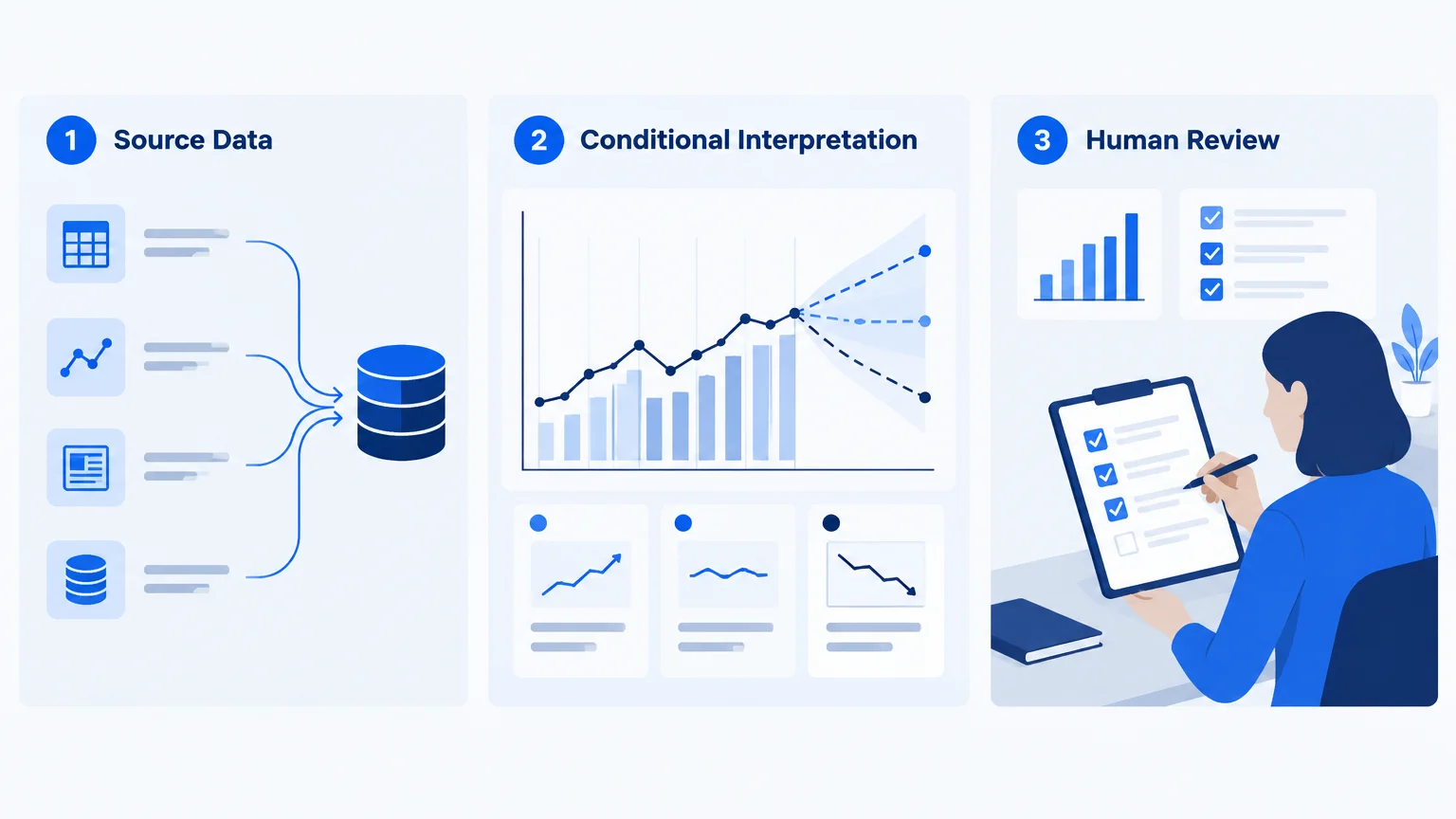
The AI trading analysis guide explains how to separate observations, interpretations and action decisions within a response.
Evaluate input quality before output polish
A well-formatted answer can be based on a blurred screenshot, an old article or an incorrectly identified symbol. Check the instrument, timeframe, timestamp and source before considering the conclusion.
For image-based tools, inspect whether scales and labels are readable. For news summaries, verify the publication date and original source. For numerical analysis, confirm units, adjustments and the period covered.
The screenshot analysis workflow provides a practical preparation checklist. Missing information should produce an explicit limitation, not a more imaginative explanation.
Demand a traceable chain of reasoning
A useful tool connects each significant conclusion to evidence. If it describes an upward structure, it should identify the visible swings. If it proposes an invalidation, it should explain why that condition weakens the scenario. If it cites news, the source should be checkable.
This does not require a long answer. A concise explanation with clear assumptions is easier to evaluate than a page of confident language. Ask what would change the conclusion and which alternative scenario remains plausible.
Be cautious when the explanation uses specialized terms without defining them. Words such as institutional, smart money or liquidity can sound precise while concealing an inference that the available data cannot establish.
Treat confidence claims carefully
A confidence score may refer to data quality, pattern classification or an internal model assessment. It is not automatically a calibrated probability that a trade will make money. Ask how it is defined and whether its interpretation has been tested on relevant data.
Performance claims need a clear methodology, costs, dates and a representative sample. A few selected screenshots or testimonials cannot establish a reliable expectation. The joint regulator AI investment-fraud alert is a useful reminder to scrutinize claims built around AI terminology.
Do not convert persuasive marketing into a larger position. Exposure should follow a risk process, not the emotional effect of an impressive interface.
Understand the limits of historical testing
A model can appear effective on examples chosen after their outcomes are known. Testing must distinguish development data from genuinely separate evaluation and include costs and realistic execution assumptions. A backtest is still a model of trading conditions, not the conditions themselves.
Ask how failures, missing data and changing market environments are handled. A method that performs differently across periods may require a more cautious interpretation than one headline number suggests.
If the provider does not supply enough information to evaluate a claim, leave it unverified. Do not fill the gap with assumptions about what a sophisticated system probably does behind the scenes.
Keep human review at the consequential steps
Use AI to organize the research question, identify visible evidence and suggest what to check next. Independently verify numerical levels, event claims and product specifications before using them in an exposure calculation.
The position-sizing guide explains why a correct chart interpretation is not a complete monetary-risk assessment. Contract multipliers, account currency and execution costs often sit outside the information supplied to the model.
A human review is useful only if it actually challenges the output. Clicking through a polished answer without checking its assumptions is not meaningful oversight.
Separate analysis from automated execution
A tool that describes a setup is not necessarily authorized or designed to place orders. Automated execution introduces additional questions about permissions, error handling and exposure control. Do not assume those functions exist because the analysis includes entry and target fields.
TradingInte is a decision-support platform. Its proposition is to find a setup, understand it, see the levels and decide. It does not execute trades for users or remove the uncertainty of financial markets.
Evaluate each feature on its actual available inputs. A screenshot-based response should not imply complete live context, and a news field should not be treated as current unless its source and timing are verified.
Use a structured trial rather than a first impression
Choose a set of representative research tasks, including ambiguous and poor-quality inputs. Record the source, question, output and corrections. Examine whether the tool identifies missing information, reads charts accurately and remains consistent about its limitations.
Measure useful outcomes beyond trade results. Did it reveal a mistaken symbol, clarify an invalidation or help reject an unsupported idea? Did it save time without hiding important uncertainty? Those observations are more informative than whether one attractive forecast happened to be right.
Compare tools using the same tasks and assumptions. Otherwise, differences may reflect the inputs rather than the systems.
Protect the information you provide
Before uploading an image or document, remove account identifiers and unrelated personal information. Understand the service's data-handling terms and provide only what the analytical task requires.
Never assume that a chart needs credentials or withdrawal permissions to be interpreted. Keep account access separate from research tools unless a specific, verified feature requires it and you understand the implications.
For an image review, the symbol, timeframe, scales and timestamp usually matter far more than the account balance displayed elsewhere in the platform.
Build the tool into a review loop
Save the original inputs and your final assessment. Later, examine factual errors, unsupported claims and useful corrections. If the same weakness recurs, adjust the task or stop relying on that capability.
The AI chart analysis guide shows how a narrow, testable request can make this review easier. The aim is not to make the model sound more certain; it is to make its useful contribution easier to verify.
Require an answer that can be challenged
A useful response leaves room for correction. You should be able to point to a source, level or assumption and ask how changing it affects the conclusion. If the system responds to every challenge with a new confident story, its fluency may be obscuring the lack of a stable method. Prefer outputs whose limits remain consistent when questioned.
Key takeaways
- Judge a tool by its actual inputs and task, not its label.
- Verify freshness, units and sources before trusting the conclusion.
- Ask how confidence and performance claims are defined.
- Keep analysis, sizing and execution as distinct responsibilities.
- Evaluate the tool on representative tasks, including failures.
Frequently asked questions
Can AI trading tools replace all market research?
No. They can organize and interpret information, but source verification, product knowledge and judgment remain necessary. A summary can omit a decisive detail even when its main points are accurate.
Is a live-data connection enough to make AI reliable?
No. Fresh data is one requirement, not proof of sound reasoning. The instrument, method, assumptions and interpretation still need to be checked.
Should I trust a published success percentage?
Only after examining its definition, sample, costs and testing method. Without those details, the number cannot support a useful expectation about your own decisions or future conditions.
What should a good tool do with unclear inputs?
It should identify the limitation and request or recommend better information. A detailed answer to an unreadable chart can be less useful than a clear explanation of what cannot be determined.
Does TradingInte place trades automatically?
No. TradingInte supports analysis and decision-making. The user remains responsible for verifying information and deciding whether any action fits their circumstances and risk constraints.
Conclusion
AI trading tools are most valuable when they make research clearer, more organized and easier to challenge. Evaluate their inputs, evidence and limits before their presentation. A tool earns trust by helping you recognize uncertainty, not by pretending uncertainty has disappeared.
Prepared with AI assistance
Keep exploring
 AI Trading
 Analysis: How AI Can Help You Read Markets More Clearly
Learn how to evaluate AI trading analysis, verify chart evidence, define scenarios and check risk without treating a model's outpu...
Read article AI Trading
AI Chart Analysis: How to Analyze a Trading Chart with AI
Prepare clear charts for AI review, check the model's observations and turn visible levels into conditional scenarios with explici...
Read article AI Trading
How to Analyze a Trading Chart Screenshot with AI
Prepare a clear chart screenshot for AI, protect account details, ask testable questions and verify the response before using its...
Read article