Stop Loss Explained: Define Risk Before Entering a Trade
Understand stop-loss planning, stop and stop-limit orders, execution uncertainty and the link between a defensible exit distance and position sizing.
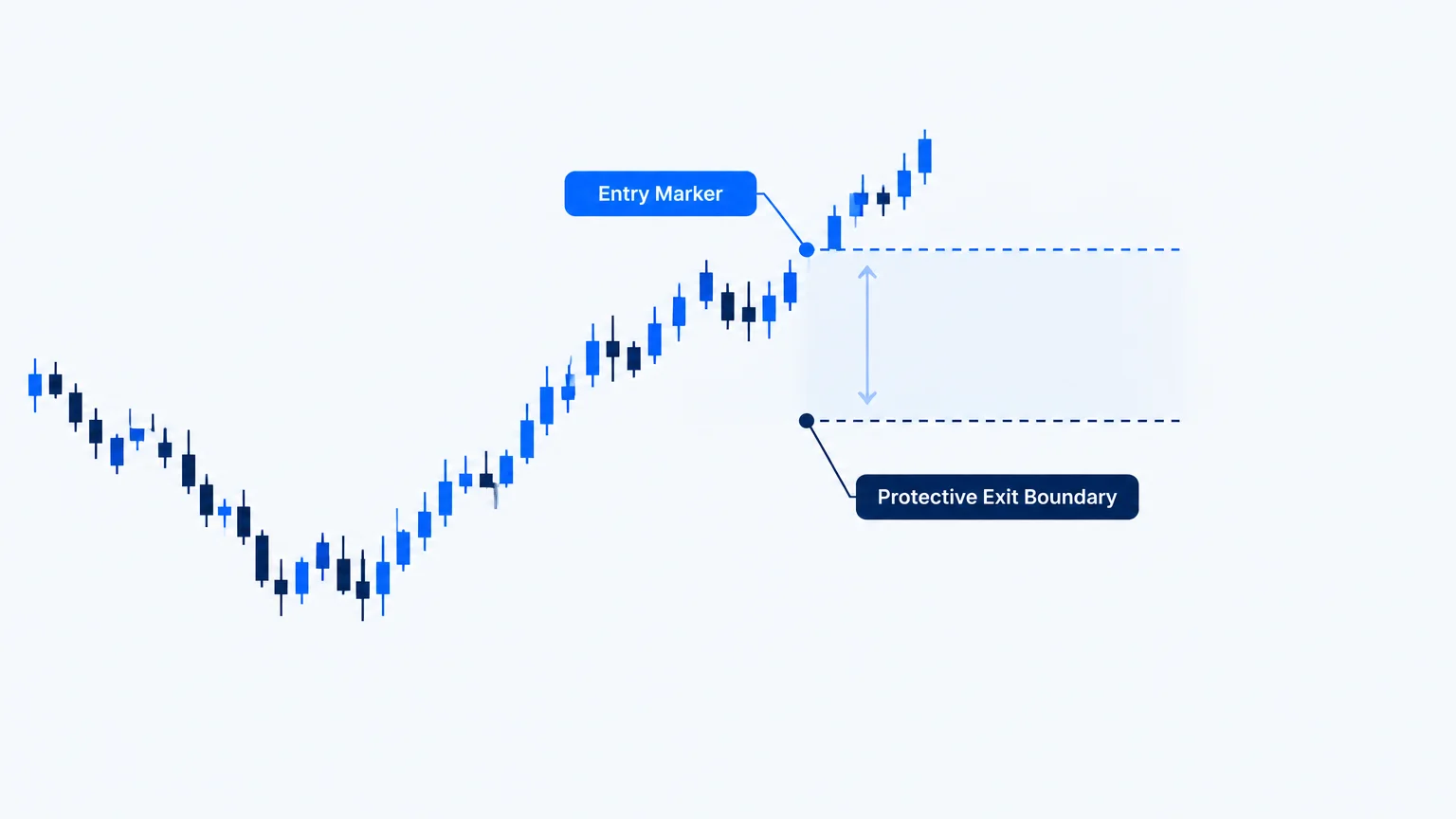
A stop loss is part of a plan for limiting exposure when a trade moves against its intended scenario. The phrase can refer to an exit rule or an actual order, and those are not the same thing. A written rule depends on being carried out. An order depends on the broker's terms, market conditions and the type of instruction submitted.
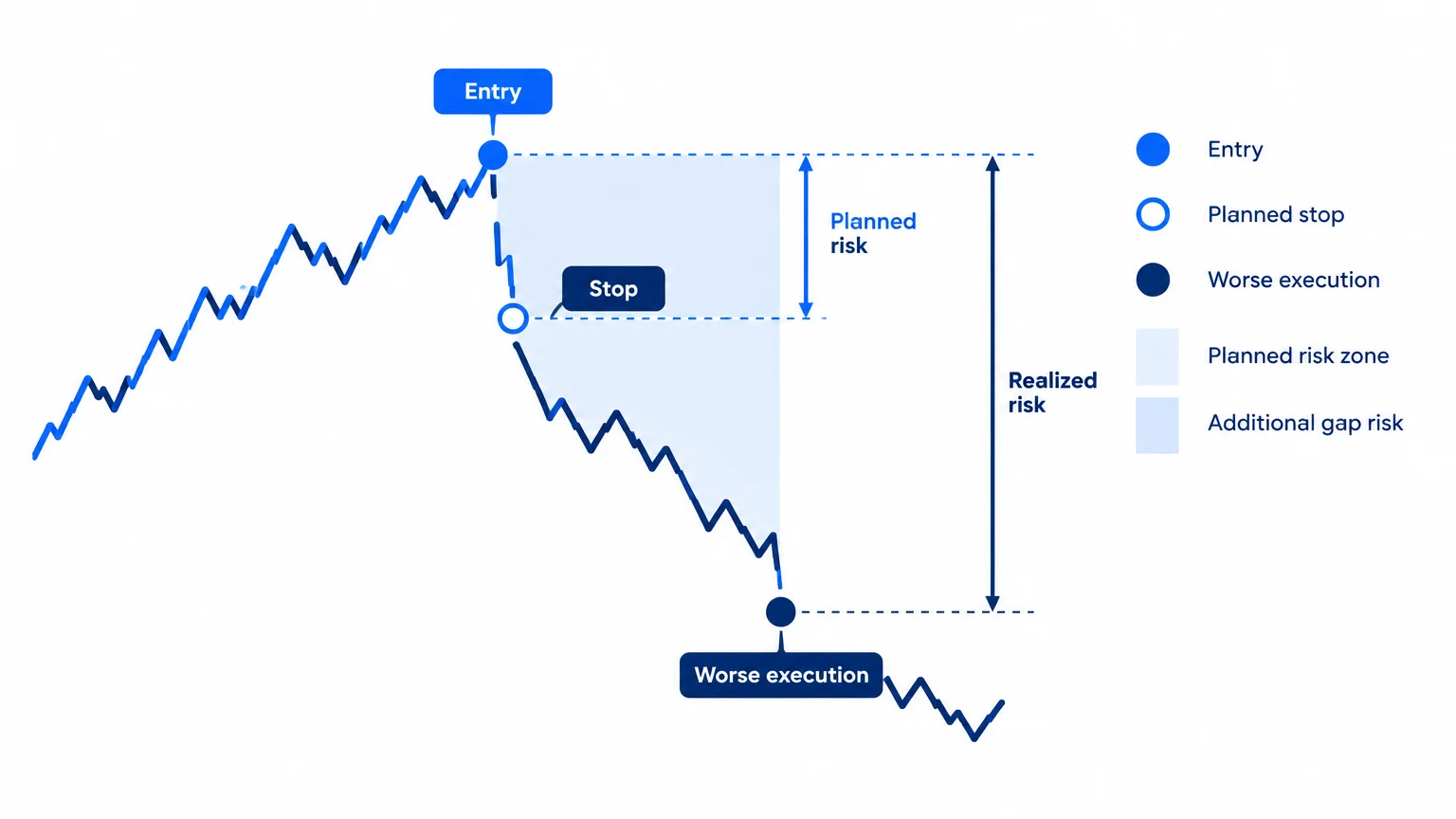
Understanding that distinction helps avoid a common mistake: treating the planned loss as an exact maximum that cannot be exceeded. Markets can gap, liquidity can disappear and execution can differ from the price used in a calculation.
Begin with the reason the trade could be wrong
Before choosing an order price, identify the condition that would weaken the setup. A continuation trade might depend on a swing low remaining intact. A breakout trade might depend on price remaining outside a prior range. A time-sensitive setup might lose relevance if the expected response does not occur within the planned period.
This is the analytical invalidation. The guide to invalidation levels explains how to define it in observable terms. A stop should reflect the strategy's risk controls, but it should not be moved simply because accepting a loss feels uncomfortable.
Understand stop and stop-limit orders
A conventional stop order becomes a market order when its trigger conditions are met. Its execution price can differ from the stop price. A stop-limit order adds a limit on acceptable execution price, but that restriction can leave the order unfilled. The SEC's order-type bulletin explains this trade-off.
Check the rules for your instrument and broker, including what triggers the order and when it is active. Do not assume the behavior of a stock order is identical to an order in another market or platform.
Place risk before position size
A common but fragile sequence is to choose a large position and then place a very close stop to make the estimated loss look acceptable. That can put the exit inside ordinary price movement rather than beyond the condition that matters to the setup.
A more coherent sequence is to define the scenario, determine a defensible exit rule, estimate the monetary risk per unit, and then calculate size. If the resulting position is impractical or the risk exceeds the budget, reject or revise the trade rather than distorting the invalidation.
The position-sizing guide explains the arithmetic and the role of contract specifications. A percentage or cash budget is a planning constraint, not a promise that the actual loss will match it precisely.
A hypothetical calculation
Suppose an educational example uses a stock entry of 50 units of currency and a planned exit at 48. The price distance is 2 per share. A position of 40 shares has a price-based planned risk of 80 before fees and execution differences.
If an overnight event leads to execution at 47 instead, the price loss would be 120. The point is not to forecast a particular gap. It is to show why the stop distance and the actual realized loss are different concepts.
These are invented teaching numbers, not a quote, recommendation or current setup. Always use the actual product specifications and your own execution conditions for a real calculation.
Match the exit to the timeframe
A daily setup can experience substantial intraday movement without invalidating its broader structure. An intraday setup may depend on a much nearer reference. Mixing a long-term thesis with a short-term stop can create an inconsistency that no indicator fixes.
If your analytical rule uses a candle close, consider what controls exposure before that close. Waiting for confirmation can allow a larger adverse move. A separate protective order may be necessary within a defined strategy, but its relationship to the close-based rule should be understood beforehand.
Do not interpret this as a reason to tolerate unlimited movement. It is a reason to make the relationship between analysis and execution explicit before taking exposure.
Account for events and market conditions
Scheduled announcements, earnings, session transitions and thin liquidity can change execution risk. A stop that behaves acceptably in ordinary conditions may behave differently during a sudden repricing. Check the relevant calendar and whether your intended holding period crosses a known event.
Spread also matters. On products quoted with bid and ask prices, the side used for execution may differ from the line most visible on the chart. A screenshot alone may not show the cost of entering and exiting.
When conditions are uncertain, reducing exposure or waiting can be more coherent than assuming a tighter stop solves every risk. A smaller planned distance does not make the market less volatile.
Decide how adjustments will work
Write rules for moving the stop before entry. A trailing approach may follow newly formed structure or another defined reference. Moving to the entry price is not automatically neutral: costs can still create a loss, and a tighter exit can remove a trade that would otherwise remain within its original scenario.
Avoid widening the exit solely to avoid realizing a loss. If new information changes the thesis, evaluate the entire position again, including the increased exposure. A new narrative does not erase the risk already taken.
The take-profit guide discusses how partial exits and stop changes interact. They should form one plan rather than a series of emotional reactions to each candle.
Keep records that distinguish different failures
After an exit, record whether the analysis failed, the execution differed from expectations, or the plan was not followed. These are different problems. A stop reached during normal movement might indicate an inconsistent placement rule; a gap may reveal an event-risk issue; a canceled stop may reveal a process issue.
Review a meaningful set of comparable trades before changing the method. One trade that reversed immediately after your exit is not proof that stops are useless. Similarly, one saved position does not justify abandoning the exit rule.
Check the order after any position change
Partial exits, added exposure and canceled orders can leave a protective instruction with the wrong quantity. After a change, verify the remaining position and the actual working orders. Do not assume a platform automatically resizes an independently submitted stop. An oversized closing order can have consequences different from the intended reduction, depending on the account and platform rules.
Also decide what happens if the connection is interrupted. A locally monitored exit rule is different from an order already accepted by the broker. Knowing where the instruction resides is part of understanding the mechanism. This is an operational check, not an invitation to change trading software: confirm the behavior supported by your existing setup and avoid relying on an untested assumption when the market is moving.
Key takeaways
- Separate analytical invalidation from an executable order.
- Understand the trade-off between market execution and price limits.
- Calculate size after defining a defensible risk distance.
- Include costs, gaps and event conditions in the assessment.
- Define stop adjustments before the trade begins.
Frequently asked questions
Does a stop loss guarantee the maximum loss?
No. The actual result depends on execution and market conditions. A stop price is not necessarily the fill price, and a price-limited exit may not fill. Read the terms for the specific instrument and broker.
Should every stop be the same percentage away?
Not necessarily. A fixed-distance method and a structure-based method make different assumptions. Whatever method you use should be consistent with the instrument, volatility, timeframe and position-size calculation.
Is moving to breakeven always safer?
It reduces some exposure but can create another problem: exiting on ordinary movement before the setup has failed. Fees and slippage also mean entry-price execution is not always economic breakeven.
Can AI choose my stop?
It can suggest a reference and explain the visible reasoning. You must verify the level, order mechanics and monetary consequences. An AI-proposed number does not replace an execution plan.
What if the sensible stop makes the position too small?
That may be a valid reason not to trade the setup. Changing the exit solely to obtain a larger position reverses the risk-planning sequence and can make the trade inconsistent with its own thesis.
Conclusion
A stop-loss plan should explain both why you would exit and how that exit is intended to occur. Establish the scenario, understand the order and size the position accordingly. The purpose is disciplined exposure control, not certainty about the final loss.
Prepared with AI assistance
Keep exploring
 Risk Management
Take Profit Explained: TP1, TP2 and TP3 in a Trading Plan
Plan take-profit levels with clear reasons, calculate blended returns from partial exits and define what happens to exposure betwe...
Read article Risk Management
Risk/Reward Ratio in Trading: Calculate It and Use It
Calculate trading risk/reward using real entry assumptions, understand R multiples and break-even arithmetic, and account for cost...
Read article Risk Management
What Is an Invalidation Level in Trading?
Define a trading setup's failure condition, distinguish invalidation from stop execution and use price, time and event rules witho...
Read article