What Is an Invalidation Level in Trading?
Define a trading setup's failure condition, distinguish invalidation from stop execution and use price, time and event rules without moving goalposts.

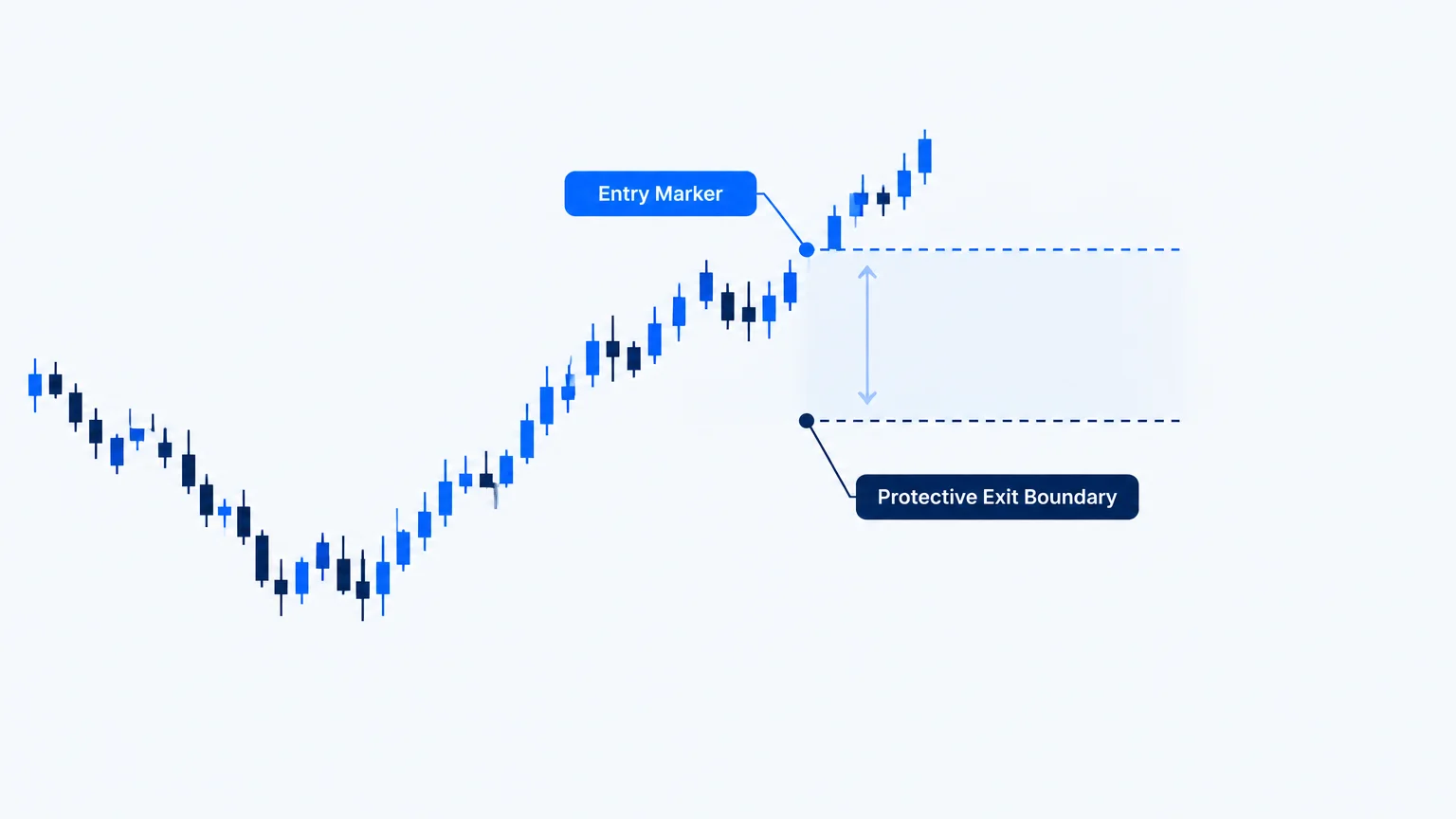
An invalidation level identifies where a trading scenario would no longer be supported under its stated rules. It answers a question that should come before the target: what would show that the idea is wrong, incomplete or no longer worth pursuing?
Invalidation can involve a price, a completed close, a structural event or a time condition. A level is useful only when the behavior around it is defined. Saying that a setup is invalid “if things look weak” leaves too much room for improvisation after exposure has been taken.
Start with the thesis
Write why the setup exists. An upward continuation might depend on a higher low remaining defended. A breakout might depend on acceptance beyond a range. A short-term reaction trade might depend on an immediate response that loses relevance if price stalls.
The invalidation should challenge that specific reasoning. A random distance from entry may serve a mechanical strategy, but it should not be described as a structure-based failure level unless the chart supports that claim.
The market-structure guide explains the swings and boundaries that often provide these references.
Distinguish analysis from execution
An analytical rule might require a completed candle below a zone. A protective order is an instruction with its own trigger and execution behavior. Waiting for the analytical condition can allow additional loss before it is confirmed.
The plan must explain how exposure is controlled during that interval. Do not assume that a close-based invalidation and a stop order at the same number behave identically. The stop-loss guide covers the practical distinction.
This separation is especially important when a model supplies an “invalidation” field without discussing an order. The label does not establish that any protection has been placed or that a maximum loss is fixed.
Define the timeframe and the test
Specify whether a touch, a trade through the area, a completed close or sustained acceptance matters. Then identify the timeframe. An intraday excursion can occur without violating a daily close rule, but it can still create a monetary loss that needs to be controlled.
Do not switch between definitions after entry. If wicks invalidate the setup when they favor your exit but are ignored when they challenge your thesis, the rule is not consistent enough to evaluate.
Use zones where appropriate, but keep their boundaries stable unless a documented new analysis changes them before exposure. An expanding zone that always contains price is not a meaningful failure condition.
A hypothetical continuation example
Imagine a fictional upward structure with a recently defended swing low. The thesis is that the next pullback will remain above that reference and produce another advance. A defined break below the reference weakens the continuation scenario.
That does not automatically prove a large downward trend has begun. It invalidates the particular upward setup. Separating those conclusions prevents an exit from turning into an immediate reversal trade without fresh analysis.
The bullish-versus-bearish guide explains why changing a short-term bias does not necessarily overturn every longer-term view.
Include time and event conditions
Some ideas depend on a response occurring within a limited period. If the expected movement does not develop, the setup may expire even though its price level has not been crossed. Define that time condition before entry rather than using boredom as an exit rule.
Events can also change assumptions. A company announcement or policy decision may make the original information stale. This does not require predicting the event's direction; it requires acknowledging that a scenario based on earlier conditions may need a new review.
Record whether the strategy is designed to remain active through known events. A technical level does not make new information irrelevant.
Let invalidation inform size
Once the relevant distance is defined, translate it into monetary risk using the actual product specification. Position size should fit that constraint. If the distance is wider than anticipated, reducing size may preserve the budget, but it does not automatically make the setup desirable.
The position-sizing guide explains the units and rounding. If the smallest permitted position exceeds the intended exposure, rejecting the trade is more coherent than moving invalidation to a convenient but unsupported location.
Also consider execution beyond the planned level. A gap can cause a larger loss than the distance-based estimate. A defensible analytical rule does not remove that uncertainty.
Avoid moving the goalposts
New information can justify a new scenario, but it should be documented as a new assessment. Widening the failure area merely because price is approaching it is different. It often increases exposure while preserving the comforting appearance of the original plan.
Ask a direct question: if you had no position, would you initiate the same idea now under the revised rules? The answer does not mechanically determine what to do, but it can reveal whether the revision comes from analysis or reluctance to accept the outcome.
Keep the original note available. Without it, later review can mistake a series of changed conditions for one disciplined thesis.
Use AI to challenge the scenario
Ask an AI tool which visible observation would most strongly undermine your interpretation. Require it to identify the chart feature and timeframe, not simply provide a numerical stop. If it cannot explain the relationship, the level may be arbitrary.
TradingInte can arrange invalidation alongside entry zones and objectives. Verify that these fields describe the same scenario. A short-timeframe invalidation paired with a distant long-term target may create a misleading reward calculation.
If the source image is unclear, the correct response is to request better information rather than assign an exact level with false confidence.
Review invalidations as information
When a setup fails, record which condition occurred and whether the planned response was followed. Do not treat every invalidation as an analytical embarrassment. A falsifiable method should expect some scenarios to fail.
The useful questions are whether the condition was coherent, whether exposure was controlled as intended and whether repeated comparable cases reveal a systematic problem. One reversal immediately after an exit does not settle those questions.
Check whether the condition can be observed in time
A rule is only operationally useful if you can detect it within the method’s requirements. If invalidation depends on a short-timeframe event that you cannot monitor, the plan and your availability may be inconsistent. Alerts can assist observation, but their settings and delivery limits need to be understood.
Write who or what is expected to detect the condition and what action follows. This turns an abstract level into a practical process without assuming automation exists. If the process cannot be carried out reliably, change the research horizon or reject the setup rather than pretending the written rule alone controls exposure.
Key takeaways
- Invalidation tests the thesis rather than protecting an opinion.
- Specify the timeframe and exact behavior that matters.
- Separate analytical failure from protective-order execution.
- Allow time and event conditions where the method requires them.
- Preserve the original rule when reviewing the outcome.
Frequently asked questions
Is invalidation the same as a stop loss?
Not necessarily. Invalidation describes the failure of an idea; a stop order describes an execution instruction. A coherent plan explains how they relate and how exposure is controlled before any close-based condition is confirmed.
Does invalidation mean the opposite trade is now valid?
No. One scenario can fail without establishing its opposite. A new directional trade needs its own evidence, trigger, invalidation and risk assessment.
Can a setup expire without crossing its level?
Yes, if the method includes a time or event condition. That condition should be defined beforehand so the decision is reproducible rather than an improvised reaction.
Should I widen invalidation after entry?
A wider level changes the risk and often the thesis. Do not do it merely to avoid recognizing failure. Any revised analysis needs a fresh exposure assessment and a record of the changed assumptions.
Can AI tell me when my idea is wrong?
It can help identify contradictory evidence, but you must verify the source and definitions. A useful response explains the condition; it does not merely provide a confident number.
Conclusion
Invalidation makes a trading idea testable. Define the failure condition before focusing on targets, connect it to practical exposure control and preserve it for review. The ability to abandon a disproved scenario is part of sound analysis.
Prepared with AI assistance
Keep exploring
 Risk Management
Stop Loss Explained: Define Risk Before Entering a Trade
Understand stop-loss planning, stop and stop-limit orders, execution uncertainty and the link between a defensible exit distance a...
Read article Risk Management
Take Profit Explained: TP1, TP2 and TP3 in a Trading Plan
Plan take-profit levels with clear reasons, calculate blended returns from partial exits and define what happens to exposure betwe...
Read article Risk Management
Risk/Reward Ratio in Trading: Calculate It and Use It
Calculate trading risk/reward using real entry assumptions, understand R multiples and break-even arithmetic, and account for cost...
Read article